 +1-480-241-8198
 +44-7428758945
 +61-1300-332-888
 +91 9811400594
Salesforce has grown into one of the most powerful CRM ecosystems in the world. But in 2026, businesses no longer want “just a CRM.” They want a platform that fits how they sell, support customers, automate work, and make decisions. Off-the-shelf Salesforce features can take you only so far. To truly unlock the platform, you need custom development that aligns Salesforce with the way your business actually works—today and in the future.
With the rise of AI, automation, Data Cloud, and industry-specific innovations, Salesforce custom development is now one of the strongest ways for companies to sharpen their competitive edge. And when done with certified Salesforce consultants, it turns Salesforce from a standard CRM into a strategic growth engine.
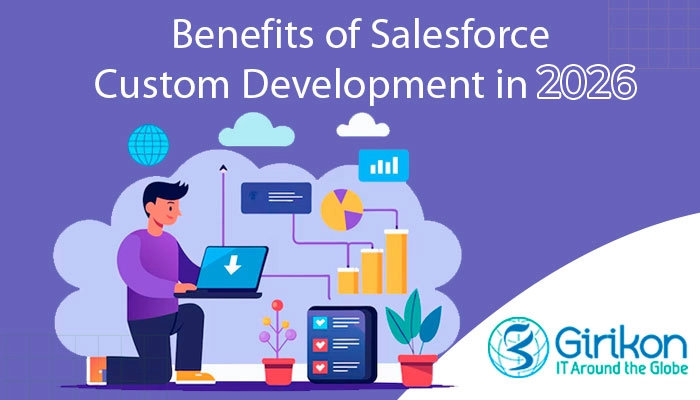
Why Salesforce Custom Development Matters in 2026
The last few years have changed how business operate. They started using remote teams, AI adoption to elevate customer expectations, and data-driven decision-making. Businesses need systems that move as fast as they do; Salesforce is at the center of this shift.
But here’s the truth: no two businesses run the same way. That’s why companies relying purely on standard Salesforce features often hit limitations. Custom development fills these gaps and helps companies build a CRM that grows with them.
1. Technology has moved beyond basic CRM
Salesforce is no longer a set of clouds; it’s an ecosystem powered by AI, automation, unified data, and industry intelligence. Custom development allows companies to use these innovations where they matter most.
2. Customers expect personal, fast, and digital-first experiences
In 2026, customers want instant answers, transparent updates, and tailored journeys. Custom Salesforce workflows and AI-driven features help businesses deliver this consistently.
3. AI + Salesforce require configuration, not generic setups
Einstein Copilot, predictive analytics, and automation tools work best when customized. A generic setup rarely brings real value. The best practice is to learn benefits of salesforce AI consulting.
4. Data Cloud makes unified data a necessity
Companies can’t afford scattered data anymore. Custom pipelines, data models, and integrations ensure Salesforce becomes the single source of truth.
5. Scaling businesses need systems that scale with them
Whether you’re expanding to new markets, teams, or product lines—custom development ensures Salesforce stays stable and adaptable.
Core Benefits of Salesforce Custom Development (2026 Edition)
1. AI-Driven Automation Tailored to Your Business
AI is only as good as the process behind it. Custom development helps you design workflows, decision logic, and automation rules that match your operations, not someone else’s. This means faster execution, fewer mistakes, and more personalized customer experiences.
2. Stronger Data Architecture with Salesforce Data Cloud
Data Cloud has become one of Salesforce’s biggest strengths. Custom development helps businesses:
- Unify customer data from multiple systems
- Build real-time segmentation
- Enable AI-driven recommendations
- Improve reporting accuracy
In 2026, companies that master their data win. Custom development makes this possible.
3. Hyper-Personalized Customer Journeys
Whether it’s service, marketing, or business rule engine, hyper-personilization help companies create experiences that feel personal and consistent. Think of automated follow-ups, predictive case routing, dynamic content, and role-based dashboards.
4. Integration Without Silos
Modern businesses run on multiple tools, ERPs, billing systems, support apps, and more. With Salesforce integration, custom development:
- Keeps data synced across platforms
- Avoids duplicate entry
- Improves visibility
- Reduces manual work
5. Better Service Delivery
Service teams get automated case handling, guided flows, AI suggestions, and streamlined processes. This means faster resolutions and happier customers.
6. Stronger Data Security + Compliance
Businesses face rising concerns around cybersecurity and compliance. Custom configurations help enforce:
- Role-based access
- Field-level encryption
- Audit trails
- Industry-specific compliance requirements
7. Mobile-Ready Operations
With custom Salesforce mobile apps, teams can work anywhere. Remote agents, field reps, and on-the-go managers stay connected—online or offline.
How Custom Development Strengthens Your Value Proposition
Every successful business stands on a strong value proposition; what makes you different from competitors. Custom Salesforce development is how you embed that value into your processes.
Before customizing Salesforce, companies should consider:
- Your operating model – Are you hybrid, remote, or in-person?
- Your customer type – B2B? B2C? Enterprise? SMB?
- Your value promise – Where does Salesforce fit into your customer journey?
Once you answer these, Salesforce becomes a tool that amplifies your strengths—not a system you need to work around.
2026 Roadmap for Implementing Custom Salesforce Development
To get the most from Salesforce, companies should follow a structured development path built around effective roadmaps for Salesforce implementation.
Step 1: Evaluate Your Current Value Proposition
Understand what your business stands for and identify the gaps in your current processes. This forms your customization blueprint.
Step 2: Work with a Certified Salesforce Development Partner
A skilled team ensures you make the right decisions faster. From planning to deployment, they help you avoid costly mistakes and build scalable solutions.
Step 3: Build the Development & Integration Plan
This includes:
- Identifying challenges and mapping them to Salesforce features
- Creating custom objects, flows, layouts, and automation
- Designing integration pipelines
- Preparing a long-term scalability plan
Step 4: Deploy, Train, and Optimize
Custom development is most effective when employees are trained well and processes are monitored regularly. Continuous optimization keeps Salesforce aligned with evolving business needs.
Salesforce Development vs DIY: The 2026 Reality Check
End-to-End Development Process
Professional developers handle everything—architecture, setup, testing, automation, integration, deployment, and support. DIY setups often lead to technical debt, slow systems, and long-term limitations.
Integration Complexity
As companies grow, they connect more systems with Salesforce. Expert developers ensure seamless, secure, and stable integrations—something DIY teams often struggle with due to API complexity and data mapping challenges.
Scalability & Performance
Businesses evolve, and Salesforce must evolve with them. Custom development ensures your setup can handle:
- More users
- More data
- More automation
- More markets
DIY setups typically do not handle this well.
Conclusion
Salesforce custom development has moved from “nice to have” to “essential” in 2026. With AI, automation, and Data Cloud shaping the future of business, custom development ensures you stay ahead — not behind. It helps organizations improve efficiency, reduce manual work, strengthen customer relationships, and build systems that support long-term growth.
If you’re exploring Salesforce development, Girikon’s certified Salesforce Consultants can help you design and implement a solution that fits your goals today and scales for tomorrow. Connect with us to explore how custom development can maximize your Salesforce investment.
About Author

Indranil is a technology enthusiast with over 25 years of experience in project management, operations, technology and business development. Indranil has led project teams in egovernance, business process re-engineering, product development and worked with Government and Corporate customers. Indranil truly believes in the power of technology to drive productivity and growth for teams and businesses.
Share this post on: